Showing posts with label Puerto Rico. Show all posts

Saturday, September 6, 2008

For my mother....

I grew up listening to this artist...when I hear his songs, his voice...it takes me back decades to when I was a  girl safe in my mother's arms:


Estando contigo
Me olvido de todo y de mi
Parece que todo lo tengo
Teniendote a ti

Y no siento este mal
Que me agobia
Y que llevo conmigo
Arruinando esta vida
Que tengo y no puedo vivir

Eres luz que ilumina
Las noches en mi largo camino
Y es por eso
Que frente al destino
No quiero vivir

Una rosa en tu pelo
Parece una estrella en el cielo
Y en el viento parece un acento
Tu voz musical

Y parece un destello de luz
La medalla en tu cuello
Al menor movimiento
De tu cuerpo al andar

Yo a tu lado no siento las horas
Que van con el tiempo
Ni me acuerdo que llevo en mi pecho
Una herida mortal

Yo contigo no siento el sonar
De la lluvia y el viento
Porque llevo tu amor en mi pecho
Como un madrigal 


Wednesday, September 3, 2008

For my mother and Puerto Ricans everywhere

BABY this song is mio mio mio para siempre!!!!!!!!!!!!!!

Déjame soñar!!!!


Tuesday, August 19, 2008

Monday, August 18, 2008

Latina Beauty

This picture of one of my lovely cousins illustrates the ethereal beauty of the Latina woman. (I'm envious of her!)...seriously though I remember how she (memory a tad foggy) was a bit of a tomboy, and with my sister would hang out together like the 2 musketeers. They were inseparable...causing mischief but fiercely loyal to their family, their roots.

I always thought she had the exotic look of a movie star.....a sultriness which came natural...it simply exudes itself from her personality. This photo is the epitome of what a gorgeous Puerto Rican lady is like.....................


Cynthia Rose discusses the challenges of Latin beauties in her article: The Challenges of 'Cha Cha': What is Latina Beauty? The article illustrates how the....Latina style loves to perform, and revels in dramatic gestures. For, in all Latino cultures, "beauty" means more than display. Beauty means the acting-out of age-old debates. Those debates - about what it looks like and means to be female - rage afresh in every generation and in every family. Says Norte: "Beauty involves your Mom, your lover, your aunts, your best friends, Hollywood, politics, Mexican movie stars, grandparents and godparents. Our kind of beauty is dialogue."


Latin beauty to me is timeless.....exotic with a touch of mystique.


On a side note:


It will be wonderful seeing my Puerto Rican family at my brother's wedding. Because of my shyness I don't keep in touch like I should but they are always in my heart.


Spending summers in Puerto Rico as a child was like a fairytale...a whole other world separate from Midwest Indiana. Being exposed to such diversity opened me up to accepting people from all walks of life, religions, cultures, creeds.....and as I grow older I do realize how important the family is and how I need to make a better effort to keep in touch.

Tuesday, August 12, 2008

Mi Familia

Abuela linda, Julia, Juliana y Ady

Tuesday, April 15, 2008

Wednesday, April 2, 2008

History of the Robles and Chamorro Families

I was conducting some research on the net as I am always wont to do and decided to find information regarding the two last names of my mother's side of the family: Robles Chamorro and found the following information:

From Ancestory.com


Robles
Spanish: topographic name from the plural of roble ‘oak’, or a habitational name from Los Robles in Lleón, named from the same word.
From 4Crests:
The associated coat of arms for this name are recorded in J.B Rietstaps Armorial General. Illustrated by V & H.V Rolland's. This Monumental work took 23 years to complete and 85,000 coats of Arms are included in this work. The surname of ROBLES is a Provencal and Spanish topographic name for someone who lived by a notable oak tree or in an oak forest. The name was originally derived from the Old Provencal word ROUVRE, and rendered in medieval documents in the Latin form ROBUR. The name is also spelt ROURE, DUROUVRE, DELROURE, DELLA, ROVERE, ROBLEDO, ROVREDO and ROVIRA. Surnames derived from placenames are divided into two broad categories; topographic names and habitation names. Topographic names are derived from general descriptive references to someone who lived near a physical feature such as an oak tree, a hill, a stream or a church. Habitation names are derived from pre-existing names denoting towns, villages and farmsteads. Other classes of local names include those derived from the names of rivers, individual houses with signs on them, regions and whole countries. In the 8th century, Spain fell under the control of the Moors, and this influence, which lasted into the 12th century, has also left its mark on Hispanic surnames. A few names are based directly on Arabic personal names. The majority of Spanish occupational and nickname surnames, however, are based on ordinary Spanish derivatives. In Spain identifying patronymics are to be found as early as the mid-9th century, but these changed with each generation, and hereditary surnames seem to have come in slightly later in Spain than in England and France. As well as the names of the traditional major saints of the Christian Church, many of the most common Spanish surnames are derived from personal names of Germanic origin. For the most part these names are characteristically Hispanic. They derive from the language of the Visigoths, who controlled Spain between the mid-5th and early 8th centuries. The lion depicted in the arms is the noblest of all wild beasts which is made to be the emblem of strength and valour, and is on that account the most frequently borne in Coat-Armour.

Chamorro
Spanish: nickname from chamorro ‘shaven head’, used especially to denote a boy or Portuguese man.

Websites:
http://www.houseofnames.com/xq/asp.fc/qx/robles-family-crest.htm
http://www.houseofnames.com/fc.asp?sId=&s=chamorro
http://www.ancestry.com/facts/Robles-name-meaning.ashx
http://www.ancestry.com/facts/chamorro-name-meaning.ashx
http://www.houseofnames.com/xq/asp.c/qx/robles-coat-arms.htm

Tuesday, April 1, 2008

Mom is getting ready to jet off to Puerto Rico


The picture I have included here found on the Wiki is where my dad proposed to my mom. I have been to this park many times growing up. Mom and Dad were married on April 16, 1966 and will be celebrating their 42nd wedding anniversary this year.
Mom's flight leaves in half an hour from Chicago to San Juan...will take about 7 hours to get there. Leaving gray cold skies to the balmy breezes of the Caribbean. Ponce's shores lies on the edge of the Caribbean ocean. I remember growing up playing in its salty recesses at La Guancha. A beautiful place for families. Well, at least it was when I was a child. It has become more developed since then and though does have some issues with reckless youth I still find it a nice retreat for the most part:
From the Wiki:
Ponce (IPA [ponse]), officially the Autonomous Municipality of Ponce, is a municipality of Puerto Rico located in the Southern Coastal Plain region of the island, south of Adjuntas, Utuado and Jayuya; east of Peñuelas; and west of Juana Díaz. It has a total of 19 wards, including the historic Ponce Pueblo (the downtown area of the city).
Ponce, the second largest city in Puerto Rico outside of the San Juan metropolitan area,[1] is named after Juan Ponce de León y Loayza, the grandson of Spanish conquistador Juan Ponce de León. It is located a few miles from the Caribbean coastline of the island. Ponce is often referred to as La Perla del Sur (The Pearl of the South) and La Ciudad Señorial de Puerto Rico (Majestic city of Puerto Rico).

Websites:


Monday, November 26, 2007

Visiting Puerto Rico


I LONG TO RETURN TO MY ISLAND...and visit my family. I really miss my grandmother. She is 87. I wish she was able to fly up here but due to poor health she cannot.

I love that I come from a large family. That my mom is the eldest of 12 and my cousins are numerous. I can easily count over 60. They have great get-togethers during the holidays. They always find an occasion to celebrate life.


When I used to visit on a more regular basis as a child I remember laughter and singing. My family was always busy. We always had things to do, people to visit. Cousins to play with. If I got bored with one I moved to another.

I yearn to return...to immerse myself in the culture. To smell the ocean, hear the wind gently passing through the palm trees. To visit Old San Juan, the mountains, the rainforest....to taste the succulent food and taste the essence of Puerto Rico....


I love spending Christmas in Puerto Rico....with the pastelles, the parandas, the merriness of my family. "Navidad is the best of Puerto Rican culture. Nowhere else is Christmas celebrated like in Borinquen. Navidad is the time of tradition, aguinaldos, décimas, y de ser jíbaro Puertorriqueño."

(A favorite song of mine when I was growing up)...........

Romance del Campesino
Roberto Cole,


En las montañas de Borinquen bella
entre la sombras de un platanar,
vive mi amada linda doncella
la jíbarita de mi cantar.
Cantan las aves en la enramada
murmura el río una oración.
Y en la ventana de mi adorada
se oyen las notas de mi canción.
Ven aca jíbarita mia
que yo voy caminito a la ciuda'
que mañana nos vamos a pasia
en tu labio fecundo amor y rosa.
Ay lara lara lara lay, lo re lo lai lerola
Mi jíbarita de tez rosada
de negros ojos y gracias mil
esta esperandome en la ventana
y sonriendo me dice asi . . .
Dios te bendiga mi dulce amadote
doy ansiosa mi bendición
y con mis besos sueño adorado
se va contigo mi corazón.
Ven aca jíbarito mio,
no te vaya a quedar en la ciudad
que mañana nos vamos a casar
y te espero solita en el bohío.
Lara la raila relo lai, lo re lo lai lerola.
No hay otra tierra como mi tierra
de ricas mieles y buen café
por eso siempre mi vida entera
en mi bohío yo vivire.
Lerolay jíbarita hermosa
no te vaya a quedar en la ciuda'
que mañana nos vamos a casar
y te espero solito en el bohío.
Ay lara lara lara la lo relo lai lerola.


Website:

Friday, November 16, 2007


Mi décima aunque no tiene


elegancia literariaes poesía legendaria


que de siglos atrás viene.


A veces quizás no suenecomo vibrante campana,


per es de raíz hispanay lleva en sus expresionescultural


es conexionescon la lengua castellana.


Ángel Pacheco AlvaradoEl Jíbaro de Peñuelas (1879-1965)


Websites:

http://www.ncteamericancollection.org/assets/pdf/aaw_poetry_essay.pdf
http://topuertorico.org/culture/litera.shtml
http://www.witchvox.com/vn/po/uspr_po.html
http://www.poetryfoundation.org/features/feature.onpoets.html?id=179552
http://en.wikipedia.org/wiki/Puerto_Rican_literature
http://www.fortunecity.com/victorian/churchmews/1216/Aguinaldo.htm

Friday, October 5, 2007

History of my Taino ancestors


I come from a diverse mix of peoples. One of them are the Tainos. My great great grandmother on my mother's side was of Taino blood. She came from a mountain village in Puerto Rico. Which btw, many Tainos fled to when the Spanish conquestadors came to enslave them.
I find this Native American culture fascinating:

The word Taíno comes directly from Columbus. The indigenous people he encountered in his first voyage called themselves "Taíno", meaning "good" or "noble", to differentiate themselves from Island-Caribs.[2] This name applied to all the Island Taínos who in the Lesser Antilles were often labeled according to their specific Taíno tribe. Locally, the Taínos referred to themselves by the name of their location.

Two schools of thought have emerged regarding the origin of the indigenous people of the West Indies. One group contends that the ancestors of the Taínos came from the center of the Amazon Basin, subsequently moving to the Orinoco valley. From there they reached the West Indies by way of what is now Guyana and Venezuela into Trinidad, proceeding along the Lesser Antilles all the way to Cuba and the Bahamian archipelago. Evidence that supports this theory includes the tracing of the ancestral cultures of these people to the Orinoco Valley and their languages to the Amazon Basin.[4]
The alternate theory, known as the circum-Caribbean theory, contends that the ancestors of the Taínos diffused from the Colombian Andes. Julian H. Steward, the theory's originator, suggested a radiation from the Andes to the West Indies and a parallel radiation into Central America and into the Guianas, Venezuela and the Amazon Basin.[4]
Taíno culture is believed to have developed in the West Indies.


Culture and lifestyle

Dujo, a wooden chair crafted by Taínos.
In the center of a typical Taíno village (yucayeque) was a plaza used for various social activities such as games, festivals, religious rituals, and public ceremonies. These plazas had many shapes—oval, rectangular, or narrow and elongated. Ceremonies where the deeds of the ancestors were celebrated, called areitos, were performed here.[5] Often, the general population lived in large circular buildings (bohio), constructed with wooden poles, woven straw, and palm leaves. These houses would surround the central plaza and could hold 10-15 families. The cacique and his family would live in rectangular buildings (caney) of similar construction, with wooden porches. Taíno home furnishings included cotton hammocks (hamaca), mats made of palms, wooden chairs (dujo) with woven seats, platforms, and cradles for children.

Taíno society was divided into two classes: naborias (commoners) and nitaínos (nobles). These were governed by chiefs known as caciques(who were either male or female) which were advised by priests/healers known as bohiques.[9] Bohiques were extolled for their healing powers and ability to speak with gods and as a result, they granted Tainos permission to engage in important tasks.
Taínos lived in a matrilineal society. When a male heir was not present the inheritance or succession would go to the eldest child (son or daughter) of the deceased’s sister. Taínos practised a mainly agrarian lifestyle but also fished and hunted. A frequently worn hair style featured bangs in front and longer hair in back. They sometimes wore gold jewelry, paint, and/or shells. Taíno men sometimes wore short skirts. Taíno women wore a similar garment (nagua) after marriage. Some Taíno practiced polygamy. Men, and sometimes women, might have 2 or 3 spouses, and the caciques would marry as many as 30.
Taínos spoke a Maipurean language. Some of the words used by them such as barbacoa ("barbecue"), hamaca ("hammock"), canoa ("canoe"), tabaco ("tobacco"), yuca ("yucca"), and Huracan ("hurricane") have been incorporated into the Spanish and English languages.

Religion

Taíno religion centered on the worship of zemís or cemís. Cemís were either gods, spirits, or ancestors. There were two supreme gods: Yúcahu,[14] which means spirit of cassava, was the god of cassava (the Taínos main crop) and the sea and Atabey,[15] mother of Yúcahu, was the goddess of fresh waters and fertility.[16] Other minor gods existed in Taíno religion; some of them related to the growing of cassava while others were related to the process of life, creation and death. Baibrama was a god worshiped for his assistance in growing cassava and curing people from its poisonous juice. Boinayel and his twin brother Márohu were the gods of rain and fair weather respectively.[17] Guabancex was the goddess of storms (hurricanes). Popular belief names Juracán as the god of storms but juracán was only the word for hurricane in the Taíno language. Guabancex had two assistants: Guataubá, a messenger who created hurricane winds, and Coatrisquie, who created floodwaters.[18] Maquetaurie Guayaba or Maketaori Guayaba was god of Coaybay, the land of the dead. Opiyelguabirán, a dog-shaped god, watched over the dead. Deminán Caracaracol, a male cultural hero from which the Taíno believed to descend, was worshipped as a cemí.[19]
Taino Descendents

A recent study conducted in Puerto Rico suggests that over 61% of the population possess Taíno mtDNA.[34] Recently, a few Taíno organizations, such as the Jatibonicù Taíno Tribal Nation of Boriken (Puerto Rico) (1970), the Taino Nation of the Antilles (1993) and the United Confederation of Taino People (an international initiative) (1998), have been established to put forth these claims. What some refer to as the Taíno revival movement can be seen as an integral part of the wider resurgence in Caribbean indigenous self-identification and organization.[35] The Jatibonicu Taíno tribe of Boriken, had reaffirmed and reorganized itself in Puerto Rico back on November 18, 1970.[36] Lambda Sigma Upsilon, a Latino Fraternity, adapted the Taíno Indian as their cultural identity symbol in 1979.[37]

References


Irving Rouse (1992). The Tainos: Rise and Decline of the people who greeted Columbus. Yale University Press. ISBN 0300056966.
Ricardo Alegría (April 1951). "The Ball Game Played by the Aborigines of the Antilles". American Antiquity 16 (4): 348-352.
Guitar, Lynne. 2000. "Criollos: The Birth of a Dynamic New Indo - Afro - European People and Culture on Hispaniola." KACIKE: The Journal of Caribbean Amerindian History and Anthropology, 1(1): 1-17 http://www.kacike.org/LynneGuitar.html
Indigenous Resurgence in the Contemporary Caribbean: Amerindian Survival and Revival. Edited by Maximilian C. Forte. New York: Peter Lang Publishing, 2006. http://www.centrelink.org/resurgence/index.html
DeRLAS. Some important research contributions of Genetics to the study of Population History and Anthropology in Puerto Rico. Newark, Delaware: Delaware Review of Latin American Studies. August 15, 2000.
The Role of Cohoba in Taino Shamanism Constantino M. Torres in Eleusis No. 1 (1998)
Shamanic Inebriants in South American Archaeology: Recent lnvestigations Constantino M. Torres in Eleusis No. 5 (2001)

Thursday, October 4, 2007

Verde Luz.............


I first listened to this when I was a kid. It is a song about Puerto Rico. Some people say it should be their national anthem. Sounds beautiful when you hear it. These are the lyrics and then I translated them so you could understand:

Verde luz de monte y mar,
isla virgen del coral,
si me ausento de tus playas primorosas,
si me alejo de tus palmas silenciosas,
quiero volver, quiero volver.

A sentir la tibia arena a dormir en tus riberas,
isla mía, flor cautiva,
para ti quiero tener.
Libre tu cielo, sola tu estrellaisla doncella,
quiero tener, verde luz de monte y mar.

Green light of mount and sea,
virgin island of the coral,
if I stay away from your exquisite beaches,
if I move away from your silent palms,
I want to return, want to return.
To feeling the lukewarm sand to sleeping in your banks,
my island, captive flower,
for you I want to have.
Free your sky,
alone your star island maiden,
I want to have,
green light of mount and sea.

Wednesday, October 3, 2007

Puerto Rican Cuisine.......que rico!!!!!!!!!!!!!!!!!!

Common Ingredients & Cooking Methods

Typical ingredients in Puerto Rican cooking are chicken, fish, seafood, avocados, calabaza (pumpkin), greens, chayote, okra, gandules (pigeon peas), apio ñame (yams), plátanos (plantains), sweet potatoes, yuca (cassava), yautía (taro root), rice, bananas, coconuts, guavas, mangoes and guanábanas. Cilantro, culantro (recao) and oregano are popular herbs.
Puerto Rican cooking is distinguished by its use of adobo and sofrito. Adobo is simply a marinade or rub, typically with garlic and lime juice or vinegar, that is used to season meat and poultry. Sofrito is a blend of ingredients - usually onions, garlic, peppers, sweet chilies, oregano, cilantro and some ham - that is used to start off and flavor a dish. Another hallmark of Boricua cuisine is achiote, a reddish-yellow oil made with annatto seeds. It imparts a distinctive hue to rice and other dishes. Puerto Rican food is not usually spicy or hot, but there are often sweet-sour combinations. Vinegar, sour orange and lime juice lend a sour touch, while dried or fresh fruits add a sweet balance to dishes.

Popular Dishes & Recipes

Pasteles, a type of tamal wrapped in banana leaves, are typical fare around Christmastime. Asopao is a gumbo-like stew that is made with chicken or pigeon peas. Pork is roasted at home as pernil al horno or sold at roadside stands where pieces are cut off a whole roast pig. Mofongo is mashed plantain mixed with pork cracklings that often serves as a meal's starch. Plantains are also popular as fried chips called tostones that are served with garlicky mojo sauce. Arroz con pollo, or chicken with rice, is considered something of a national dish.
And don't forget rum! Puerto Rico makes some of the world's best.

Thursday, September 20, 2007

Bringing culture closer to home

I WAS ONE OF THE LUCKY ONES....RAISED IN 2 CULTURES=AMERICAN AND PUERTO RICAN. Of course growing up in the midwest-the middle of corn country--the kids in school tried to make feel ashamed of being mixed and for a while I was...until I realized as I grew older that I should be and am proud to be from such a rich culture. I have two countries to be proud of and two languages I have mastered.

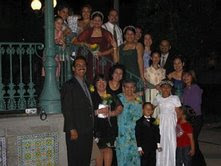
Since I live in the midwest it is pretty homogenous as far as ethnic diveristy. When I attended college I wanted to surround myself with people from all over the world. I was lucky to help co-found the International Student Organization at Indiana State University. (Picture included of some of us at a friend's apartment. The couple were originally from the Caucus)We had people from all over and man, what fun we had. I was the MC for an international fashion show, we had students create delicious dishes of their favorite home cooked meals, a dj to play songs from around the globe, just a simple communal gathering celebrating life.


Now that as I grow older I find myself missing these things and need to get out more, to explore my Midwestern roots, my world...to once again find people who entrance me so, motivate me...I want to bring a piece of the world back into my heart as I did so long ago. I think it is important for children to learn about the world out there---technology has brought everyone closer...we can scan for unlimited resources on the 'net...computers, planes, anything that involves the advancement of human beings in science and the medical realm have brought our countries together---almost blurring borders--almost I say because we still retain our ethnic pride and culture identities....I believe that as human beings we should all try and understand people who believe differently than we do and celebrate life in other ways than our own.

Tuesday, September 18, 2007

Puerto Rican Recipes


I just love Caribbean food. Man oh man...I remember as a little girl spending my summers in Puerto Rico and my abuela (grandmother) cooking up some arroz con pollo (rice and chicken) and with some lip smacking beans...GOD it is making me sooo hungry right now. Found this website on food and is a great quick link to a variety of Puerto Rican delicacies and simple dishes.

http://www.recipehound.com/Recipes/puertorico.html

I am planning to make this dish for a potluck lunch at my work on the 27th. I pray it turns out alright:


Chicken with Rice Aibonito (Arroz con Pollo a lo Aibonito)
Servings: 10-12 people

INGREDIENTS:
2 whole bone-in chicken breasts with skin, cut into 2-inch pieces
1 recipe traditional garlic dipping sauce
1/4 cup olive oil
1/2 cup black olives, pitted and chopped
1/3 cup golden raisins
1/2 cup green peas
1 6-ounce jar pimientos, drained and cut in strips
4 cups long-grain rice
4 to 5 cups chicken stock
generous pinch saffron, soaked in an additional 1 cup boiling chicken stock
2 teaspoons salt
1 teaspoon black pepper

Marinate the chicken pieces in the dipping sauce for 30 minutes. Drain and discard the liquid. In a skillet, heat 2 teaspoons oil, lightly saute the chicken pieces, and set aside. Heat the remaining olive oil in a Dutch oven. Saute the olives, raisins, peas, and pimientos for 5 minutes. Stir in the rice. Add enough chicken stock, including the cup with saffron, to cover the rice, and bring to a boil. Add salt and pepper. Reduce the heat and add the chicken. Simmer for 20 minutes, or until the rice and chicken are cooked.

Today I turn 39

WOW....hard to believe. My mom called and had my grandmother on the line. They sang Happy Birthday to me in Spanish. I love the songs:

Estas son Las manañitas
(These are the morning songs)
que cantaba el Rey David. (that King David sang.)
Hoy por ser día de tu santo (For today to be the day of your saint)
te las cantamos así. (we sing to you like this.)
¡Despierta, mi bien, despierta! (Wake up, my dear. Wake up!)
Mira que ya amaneció. (See that it is already dawn...)
Qué linda está la mañana en que vengo a saludarte...
(How beautiful is the morning in which I come to greet you...

Feliz, feliz en tu día,Amiguito(a) qué Dios te bendiga,Y qué reine la paz en tu día,Y qué cumplas muchos más.

Happy, happy on your day,Friend, may God bless you,May peace reign on your day,And may you have/complete many more (birthdays, years).

Thursday, July 5, 2007

The Essence of Family


I remember Puerto Rico as this island Paradise where I could roam as a child safe from harm, always had a huge family to go back to, play with, learn from. I took for granted visiting this little island in the Caribbean. Now that I am older I realize how much I miss going there. Finding the time to go and the $$$$ seems more difficult now then before. I feel guilty not being able to see my grandmother and I wish I could just fly down there and say hello, bendicion. How are things? Many things go through one's mind as we get older what we should do, what is proper. I missed out on so much of my family there. Sometimes I feel like a stranger. Not really a part of that central unit. I should have made a better effort at making time to go down there before it becomes too late.

Tuesday, July 3, 2007

Isla


I love this website. If you have time ck it out for some great Caribbean buys!


Monday, July 2, 2007

Puerto Rican Food


I love love love most PR foods. Some people think that Puerto Rican food is like Mexican, however it is not! PR food is less spicey (think hot spicey). We tend to eat more fruits, veggies and fish. Here is a website that contains a listing of Goya products great for fixing up a PR meal and links to other ethnic foodstuffs:


Being Puerto Rican


I grew up on the brink of two worlds: The majority of being Caucasian and the minority of being Hispanic. My mother is Puerto Rican while my dad is of Irish descent. He met my mother while in the Navy. I had to face racism very early. Was hard. I sometimes did not know which world I belonged to and had to fight to be accepted into mainstream society for being what some of my high school classmates dubbed me as: a "halfbreed". With the world changing and mixed families being quite common I wonder about these very same high school hooligans who used to poke fun at my rich heritage. I have never attended any of my high school reunions due to still be sensitive over the bigotry I faced as a teen. As an adult I realized I should never let anyone have that kind of perverse power over me. I am proud to be Latina, I am proud to be White. I have the best of both worlds and embrace them both.